By Gregory Chabot:
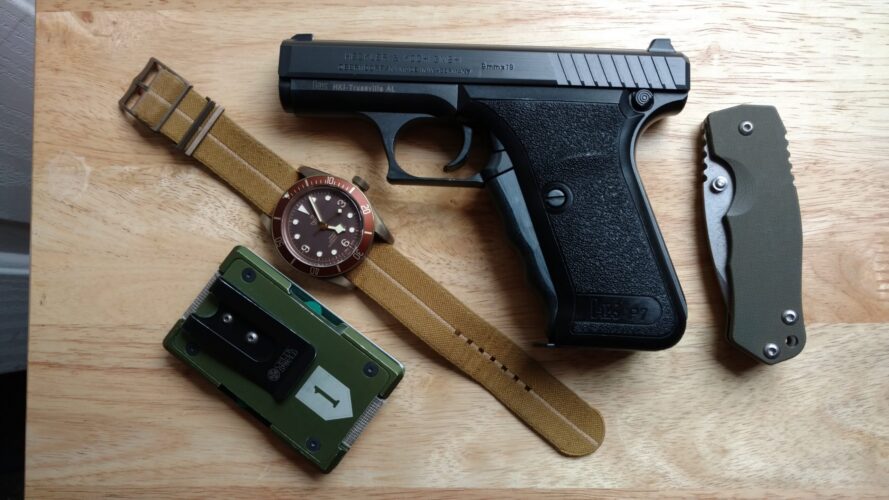
We live in a great time to be gun owners. There are endless options for EDC guns and depending on who you ask, the answers vary all over the internet. My main requirement for my EDC is reliability and ease of use first and foremost. And the Heckler and Koch P7 series meets those requirements.
A little history:
Designed in the early 70’s by Helmut Weidle, it was revealed in 1976 as the Police Self-Loading Pistol. Going into production in 1979, to fulfill West German police contracts, which required the weapon to be rendered completely safe if dropped by an officer. To meet this requirement the P7 was designed with a unique squeeze cocking mechanism to prevent negligent discharges.
The P7 earned a reputation for safety and reliability with West German police agencies. With success in Europe, Heckler and Koch began to import the P7 with some design changes for the US, hoping to break into the highly competitive police market. Due to cost, the P7 did not see widespread adoption with US law enforcement agencies. During that time, the P7 family was the most expensive production handgun in the world. Heckler and Koch ran an advertising campaign to explain why the P7 was so expensive.
With the advent of the “Wonder Nines” in the 1980s, sales of the P7 began to decline. To compete, Heckler and Koch released the M13 variant with a 13+1 capacity. With less costly options available, the P7 series became more of a connoisseur gun with production ending in 2008. Today the P7 series is sought after by collectors and shooters alike, commanding a premium on the used market due to its high quality and craftmanship.
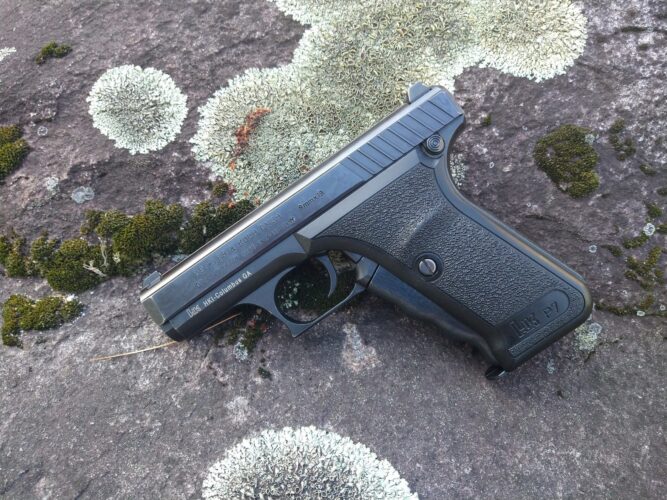
The focus of this article will be on the original P7 PSP, which I use as my EDC. The sample was a former Lower Saxony Police issue, made in October1985. Polizei issued P7s have the month and year made stamped on the slide. Heckler and Koch imported them in the late-2000 timeframe when many German Police agencies were switching to the HK P30. Before importation, all weapons were thoroughly checked, and parts were replaced as needed. Some were refinished by distributors, others were not.
Design features of the P7 PSP:
The HK P7 is an all-steel, striker fired weapon that uses a unique gas-delayed blowback system. Which uses gas pressure from the fired cartridge to retard the rearward motion of the slide. This is accomplished by means of a piston inside a cylinder located under the barrel. That opposes the rearward motion of the slide until gas pressure has decreased allowing the empty case to eject. The P7 uses a fixed 4.1” CHF (cold hammer forged) barrel with polygonal rifling and low bore axis. The chamber has 18 flutes to facilitate extraction. The eight-round magazine is constructed of steel and sits at almost 90 degrees to the chamber ensure reliable feeding of rounds. The PSP magazine release is located on the butt of the weapon and is of the friction type.
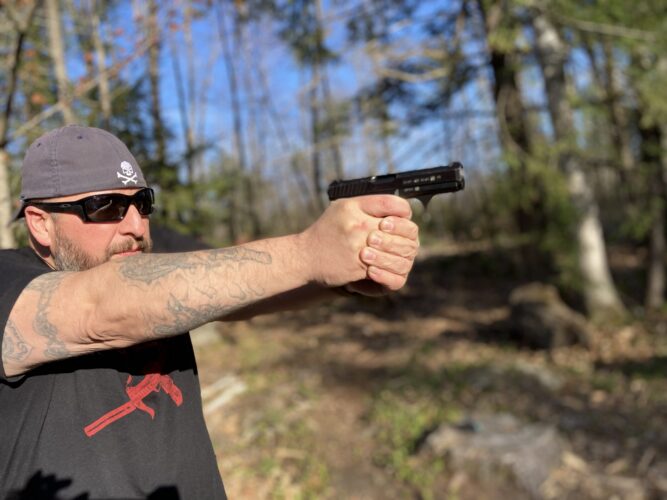
The grip of the pistol contains the cocking lever. Before the P7 can be fired it must be squeezed as it acts as the safety. It takes around 16lbs to squeeze it and cock the striker. Only 2lbs are required to keep it cocked. When fully cocked, the end of the striker will protrude from the back of the slide and there will be an audible click. The weapon is then fired by squeezing the trigger. If the lever is held in, the P7 operates like any other semi-auto handgun. If the lever is released, the weapon is de-cocked and rendered completely safe. It is a very easy manual of arms to learn, and with practice, allows fast deployment and a large margin of safety for concealed carry. You must make a conscious decision to fire this weapon. In my opinion it is nearly impossible to have a negligent discharge with this weapon. By design the P7 is completely drop-safe.
Field stripping:
The P7 is a simple weapon to clean and fieldstrip. First ensure the weapon is clear by removing the magazine and checking the chamber. With the weapon in battery, push in the disassembly button and pull the slide to rear and up then forward off the frame. Cleaning is straight forward with some differences. The piston just needs a wipe with a rag, it does not require lube or heavy scrubbing. To clean the gas cylinder, use the provided tool. If the weapon does not have tools, you need to buy them. It is not advised to use a screwdriver to scrape the cylinder. If the cylinder is damaged, you will now have a very expensive paperweight that will need a trip to Oberndorf Germany to hopefully be repaired.
So please, buy the tools. In the chamber, there is a small hole that allows gas in to extract the case, use a paperclip to keep it clear. To clean the striker, reassemble the weapon. Then cock the weapon so the striker is even with the back of the slide, then remove the striker assembly with the provided tool. This only applies to the PSP; later models eliminated the need for a tool to remove the striker assembly. I find this feature a great safety option as one can keep the P7 loaded but render it inert without the striker to prevent unauthorized use.
Shooting the P7:
The P7 is a pleasure to shoot and extremely accurate. Contributing factors are the excellent trigger and ergonomics of this weapon. While designing the P7, Helmut Weidle studied the human hand to come up with the optimal grip angle of 110 degrees. Which makes for a very comfortable grip and natural point of aim. Very similar to pointing your finger at the target.
The trigger on the P7 is the best striker trigger I have ever used. A true single action with a smooth take up and a clean break with no grit or creep. Reset is short, allowing for fast follow up shots. Weight of the trigger on test weapons came in at 4lbs. The sights are steel three dot type, that are very easy to pick up.
The P7 is very flat shooting with very little felt recoil due to the operating system. The one drawback is after a few mags it does get hot. Keep in mind, the P7 was designed as a duty weapon for Police to be fired then re-holstered. When they hit the US market that was one of the complaints from end users. HK added a polymer heat shield to the P7M8 and later models. Without gloves I could fire 4 mags before it got uncomfortable for me. Many P7 users will have a second one to rotate them while taking a class, etc. Which is not a deal breaker, as a civilian concealed carrier, if I fire an entire magazine and must do a reload, that means I screwed up royally; I only carry a spare mag in case of a malfunction.
I liked the simple manual of arms while shooting drills. Draw, squeeze, fire. There isn’t much of a learning curve and a little practice goes a long way. Shooting Mozambique drills was fast and efficient due to the trigger and low recoil. Shooting the El-Pres, the low bore axis and natural aiming made transitioning targets easy and accurate. With the one drawback of a slow mag change with the heel release. As I stated above, it is not a big deal to me.
The cocking handle also doubles as the slide release which helps to save time when reloading. If you practice the fundamentals, you shouldn’t have any accuracy issues with this weapon. I have let new shooters try mine and they had no problem hitting the target. Reliability has been 100% with any ammo I’ve used with, around 5k through both of mine over the years. There is a video online that HK produced for marketing. They removed the extractor from a P7, and the weapon functioned without it due to the fluted chamber.
Pros and Cons of the P7 series:
I wanted to include this to help readers decide if the P7 is right for their needs.
Pros:
1) Accurate and reliable.
2) Best production semi-auto trigger I’ve ever shot.
3) Simple to operate and maintain.
4) The safest handgun I have ever used or carried.
5) Excellent ergonomics.
6) Outstanding quality.
7) Easy to conceal and snag free.
Cons:
1) Expensive to buy on the used market.
2) Magazines can be hard to find and expensive.
3) Parts if needed can be difficult to find.
4) Slower reloads (PSP), fluted chamber is hard on brass if you are a reloader.
5) Gets hot with prolong use.
6) Everyone at the range will want to shoot it. Then pester you to sell it.
7) Holsters can be hard to find. (Depending on model)
8) You’ll want more than one.
I will also include some things to look for if you find one for sale. I base this on my own experience when I purchased mine many years ago.
Buying tips for the P7 series:
Do your research and look for the model you want. Ask to take the grips off and check the internals. Look for any unusual or heavy wear. When the German Police trade-ins were imported, distributers used a grading system, which was more for cosmetic reasons than anything else. I have seen a grade C that had better internals than a grade A. Keep that in mind if you are looking for a shooter. The internals are key to this weapon functioning properly. Try the action, it should be smooth without a gritty feel same with the trigger. Ask to fieldstrip it and check the piston and cylinder for wear or damage. With the prices asked for, a seller shouldn’t have an issue with letting a prospective buyer do the above. If they do, my advice is to walk away.
The HK P7 came from a very innovative time in firearms history. The craftsmanship and intricacy of the cocking mechanism show how much thought was put into engineering this fine weapon. The reliability, accuracy and safety make the P7 an excellent choice for concealed carry even today, 50 years after it was first unveiled to the shooting world. Yes, I would have no qualms recommending this weapon to family or friends. I trust my life every day to the HK P7 PSP, enough said. If given the opportunity to shoot one, do it and you’ll realize why it is one of my favorite guns of all time.
There is a company called P7Pro that is in the process of making new production P7s. With more modern features such as a rail and optics option. As of this writing, they are in production and available, but not cheap.
About the Author: Gregory Chabot