
Why You Need a Short-Wave Radio
by Greg Chabot
During emergency situations information is just as valuable as water, food and ammo. A good radio with short-wave capability should be an essential part of your plan. Why short-wave? I like to receive information from different sources that cannot be controlled by government agencies. As we have seen, the media likes spin stories and manipulate how people think. Short-wave gives one access to different viewpoints to form their own opinions. From sources across the globe.
What is short-wave? I’ll put it in layman terms SW was the internet before computers. It is a radio transmission using frequencies in the short-wave band. It includes all high frequency bands which extends from 3 to 30 MHz above medium frequency to the bottom of the VHF band. SW waves can be “bounced” off the ionosphere allowing it to travel great distances. Which means one can pick up stations from around the world. And contrary to popular belief SW is still going strong in the age of streaming off the internet.
Radios that I use:
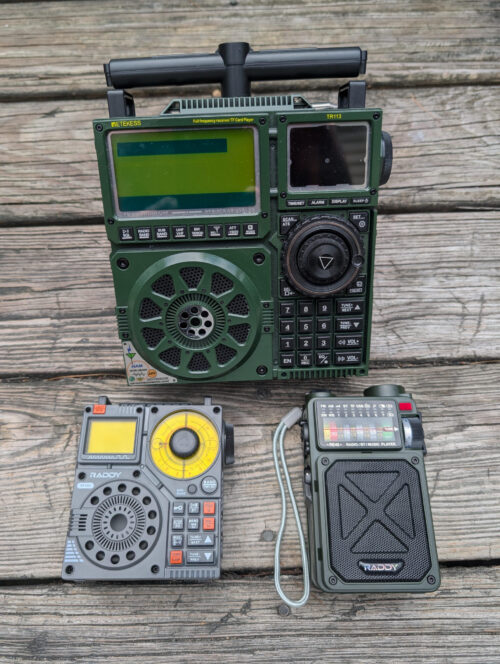
When I first got into using short-wave, I bought a Raddy RF320 followed by a Retekress TR113 and for emergency use a Raddy RE40 solar powered radio. The RF320 provides great bang for the buck and good battery life. It comes with a nice wire antenna that can be clipped to the telescopic antenna for better reception. It has AM, FM, Air band, VHF, Weather band and Short-wave. It is simple to use and compact and I recommend it as your first radio.
Wanting to explore more I bought the Retekress TR113 as it has all the features above and the ability to listen to SSB (Single side band/Ham) and LW (Long wave). On LW I’ve picked up a numbers stations and listening to SSB I’ve learned a lot about things going on around the world. It is a larger radio and has a good battery life. Both have excellent sound quality to my deaf ears. VHF can pick up local comms and emergency services which can also be handy in bad weather or emergencies depending on your area.
There are two ways to tune these two radios, manually or digitally. Both ways work well and depending on your area you should be able to pick up stations with ease. For shortwave end users might have to wait until night as most SW stations don’t broadcast 24/7, I’ll include a link to a site that will help you find SW stations. I had no issues getting SW stations with my improvised wire antenna attached to the radio’s antenna. You’ll have to experiment to see what stations you’ll receive. And you might need to use a wire antenna for better reception as geographic area and weather can affect SW signals. I like the weather band function as I can get accurate reports without the climate change nonsense that state run media likes to promote every chance they can get.
The last radio I use is the Raddy RE40 marketed as an emergency radio. Unlike other emergency radios the solar charger works well and keeps the battery charged. I have charged this radio from lights in the house! The battery can also be charged via an outlet with the included cord. While charging devices it does a good job, but it does take time. The hand crank also works well and can be used to charge phones and other devices in a pinch. It does take a lot of time, keep that in mind. For a small radio the sound quality is amazing! I have severe hearing loss from my military service, and I can hear it clearly from a good distance. Friends that have better hearing than I have complemented on the sound quality. I’ll take their word for it. This radio is tuned manually, be patient and you should be able to find stations.
I have been using this radio on a regular basis for a year. It hasn’t disappointed me either on the beach or in the woods. In below freezing temperatures the battery held a charge with no loss of performance. I have no qualms about recommending this radio as part of one’s emergency preparedness as SW can keep one better informed than AM or FM in emergency situations. Keep in mind it is wise to take it out and check the charge on occasion and charge if needed.
Tips:
A good antenna can be very helpful. One can purchase them on Amazon; I put mine by a window and it works great. Reception can vary there is a station in Maine WBCQ that I can barely get. WRMI in Florida comes in as clear as satellite radio. WWCR is another that is hit or miss for me. That is the fun part of this hobby. I sometimes get a station from N.Korea and they promise to liberate me from my capitalist oppressors!
Don’t let all the buttons intimidate you. I am very weak in the comms/Tech department. I watched some you tube tutorials and just played around with settings etc. And I figured it out in no time with a little patience.
Most of these radios are made in the PRC and most are probably made in the same factory with a different name slapped on. I advise shopping around and read the reviews. The three I mentioned have served me well over the years with no issues.
The following link is for Short-Wave.info this site provides information on what SW stations are broadcasting. You just type in any station and your preferred language, and a list of station frequencies will come up along with what program is on. It is very helpful when listening to Shortwave and will save you time searching for a station you want to listen to. Don’t be surprised if you find a pirate station or two, they can be very entertaining! A short-wave capable radio should be part of your preparation plans as it offers more than a standard radio. As I said earlier, information can be a life saver, and short-wave allows one to get alternative news/information.
About the Author: Gregory Chabot